Choosing a reliable 30 amp DC to DC charger improves how your vehicle, boat, or RV maintains battery health while on the road or water. The following selections cover top brands, smart charging, MPPT integration, and Bluetooth monitoring to help you keep service batteries charged without overworking your alternator. Each option supports multiple battery chemistries and is designed for dual battery setups. Read on to compare features, compatibility, and safeguards so you pick a charger that fits your power system and lifestyle.
Summary of chosen products (by model and key trait):
- Victron Energy Orion-Tr Smart DC to DC Charger — Non-Isolated, 12/12V, 30A
- Victron Energy Orion-Tr Smart DC to DC Charger — Isolated, 12/12V, 30A
- Renogy DC to DC Charger with MPPT 12V 30A — Multi-Stage Smart Charging
- Renogy DC to DC Charger 12V 20A — Bluetooth Compatible, Safety Features
- Renogy DC to DC Charger 12V 60A — Multi-Stage Smart Charging
Victron Orion-Tr Smart DC-DC Charger Non-Isolated 30A

The Victron Orion-Tr Smart DC-DC Charger is designed for professional, three-stage charging to safely top up service batteries used in dual battery arrangements. It supports vehicles and boats where the alternator charges a separate starting battery that powers a secondary battery bank. Built-in Bluetooth provides easy monitoring and configuration through the VictronConnect app, enabling real-time status checks and adjustments from a smartphone or tablet. This non-isolated version is appropriate for installations needing a straightforward, compact charger with robust protection features.
Victron Orion-Tr Smart DC-DC Charger Isolated 30A

This isolated version of the Orion-Tr provides the same three-stage charging as the non-isolated model but with electrical isolation between input and output. Isolation can be important in complex electrical systems to prevent ground loop issues and cross-talk between batteries. The charger includes Bluetooth for remote monitoring via VictronConnect, ensuring you can verify charging status, setpoints, and diagnostics without opening the hood or accessing the device directly. It’s especially suitable for sensitive systems where isolation improves safety and performance.
Renogy DC to DC Charger with MPPT 12V 30A

Renogy’s 30A DC-DC charger combines MPPT solar optimization with three-stage charging to maximize solar input while alternators remain active. It prioritizes solar energy when both solar and alternator sources are available, helping reduce fuel use and extend battery life. The charger supports lead-acid and lithium chemistries, including AGM, Gel, flooded, and LiFePO4. It provides protection against over-voltage, over-temperature, and reverse polarity, and it isolates input and output to prevent electrical interference with house batteries. Ideal for RVs, boats, and dual-battery setups.
Renogy DC to DC Charger 12V 20A

Renogy’s 20A model focuses on a simple, compact installation with safe startup and charging logic. It includes internal safeguards to protect both the vehicle’s starter battery and the house battery bank, including compatibility with LiFePO4 activation and a one-touch operation for enabling or disabling advanced battery features. It’s designed for easy mounting and safe spacing between input and output terminals to reduce risk of short circuits in tight spaces such as under vehicle dashboards or boat engine rooms. A practical option for smaller power needs.
Renogy DC to DC Charger 12V 60A Multi-Stage
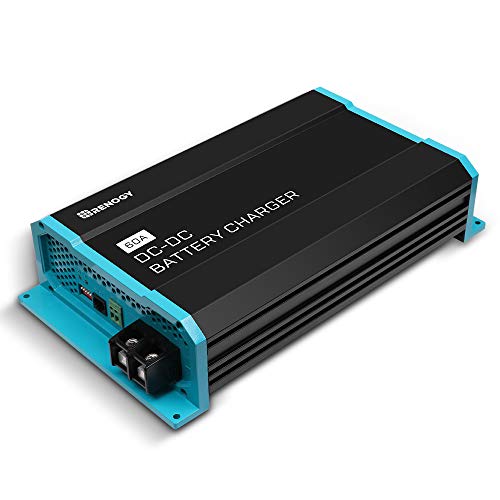
The Renogy 60A DC-DC charger is a higher-capacity option suited for larger dual-battery systems with heavy loads. It provides a three-stage charging profile (Bulk, Boost, Float) and supports a broad array of battery chemistries including LiFePO4 and various lead-acid types. Protections include over-voltage, over-temperature, reverse polarity, and input-output isolation to prevent cross-talk between the engine and house circuits. Its robust design makes it a strong choice for RVs, boats, and off-grid vehicles that demand more power and reliability from a single charger.
Buying Guide: Key Considerations For Selecting A 30A DC-DC Charger
- Charging Architecture: Decide between isolated or non-isolated to suit your electrical system and potential interference concerns. If you operate multiple batteries and sensitive electronics, isolation can be beneficial.
- MPPT and Solar Compatibility: If you use solar panels, MPPT-enabled units maximize solar input and improve efficiency, especially when alternator output is variable.
- Input/Output Protections: Look for over-voltage, over-temperature, short-circuit, and reverse polarity protection to guard both starter and house batteries.
- Battery Chemistries: Ensure compatibility with your battery types (lead-acid, AGM, Gel, flooded, LiFePO4). Some models include LiFePO4 activation or smart learning features.
- Monitoring And Control: Bluetooth or app-based monitoring helps track charging status, voltage, and health without direct access to the charger, which is convenient for remote installations.
- Installation And Space: Consider size, mounting options, and required air flow. Some units have compact housings suitable for tight engine bays or boat compartments.
- Future-Proofing: If you anticipate expanding your dual-battery setup or changing battery types, choose a charger with adjustable charging profiles and higher output headroom.
- Brand Ecosystem: Choosing a product from a brand with a mature monitoring app and reliable customer support can simplify setup and troubleshooting.