Choosing the right 3-way occupancy sensor switch can dramatically improve energy savings, convenience, and lighting control in shared spaces. This guide highlights top options that support multi-location switching, reliable motion sensing, and easy installation. Each model below is selected for compatibility with 3-way setups, broad load ranges, and solid build quality for both residential and commercial settings.
| Product | Brand | Key Feature |
|---|---|---|
| Leviton DOS15-1LZ | Leviton | Multi-way compatible; wide coverage |
| Maxxima 3-Way | Maxxima | Manual/automatic modes; 180° PIR |
| Lutron MS-OPS5M-WH | Lutron | No neutral required; simple 3-way integration |
| EverElectrix 2 Pack | EverElectrix | 3-Way occupancy with adjustable timer |
| ECOELER 3Way PIR Switch | ECOELER | 3-way with neutral; Title 24 compliant |
The products below are compact, compatible with common wall boxes, and designed to minimize false triggers while maximizing energy savings. Each entry includes a quick overview, practical use cases, and setup considerations to help you decide how a 3-way sensor switch fits your space.
Leviton Decora Occupancy Sensor in-Wall Switch

Leviton’s DOS15-1LZ is a versatile 3-way occupancy sensor switch designed to automatically turn lights on or off based on motion. It offers a broad 180-degree field of view and about 900 square feet of coverage, making it suitable for living rooms, hallways, or entryways. It supports high wattage loads, including LED, CFL, incandescent, and voltage conversions, with a robust 15A rating. The device’s slim profile fits most wall boxes, simplifying installation for DIY enthusiasts and professionals alike. In multi-sensor configurations, it works with a companion unit or with two DOS15 sensors to cover complex spaces such as L-shaped rooms.
Best use cases include stairwells, large living spaces, and offices where motion occurs in multiple directions. When installing, ensure the companion switch is properly paired for a seamless 3-way operation. The Leviton unit is well-suited for retrofit projects due to its slim form factor and wide compatibility with various lighting loads.
Maxxima Occupancy Vacancy Motion Sensor Switch

Maxxima’s 3-Way or Single Pole occupancy sensor switch supports both occupancy and vacancy modes, offering energy-saving automation with manual override. The 180-degree PIR sensor is complemented by a green LED backlight for easy visibility in dim environments. This model ships with a wall plate and wire nuts, facilitating quick, straightforward installation. Adjustable time delays—from short to lengthy periods—let you tailor how long the lights stay on after movement is detected. The dual-mode capability makes it suitable for hallways, storerooms, or reception areas where space layouts vary.
With its straightforward 3-way compatibility and configurable delay settings, this Maxxima switch is a practical choice for those who want flexible operation without complex wiring. It helps reduce energy use in frequently trafficked areas while preserving convenience through automatic on/off behavior.
Lutron Maestro 3-Way Motion Sensor Switch
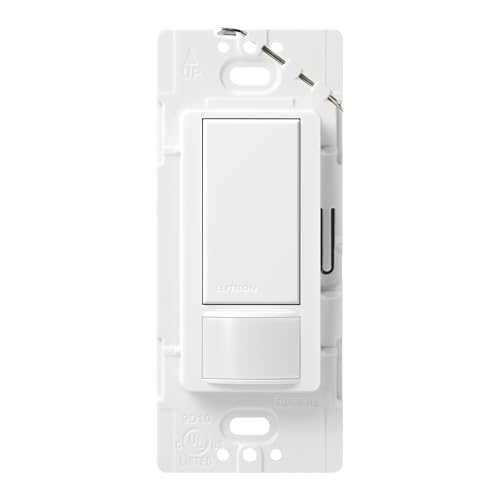
Lutron’s MS-OPS5M-WH is a popular no-neutral, 3-way-capable occupancy sensor switch designed for indoor use in bathrooms, garages, laundry rooms, or closets. The Maestro line focuses on reliable motion detection and straightforward operation, allowing automatic lighting control as you enter and exit a space. It is especially valuable in areas where there are frequent task-based movements, reducing the need to manually switch lights off. Since no neutral is required, it can simplify wiring in older homes or retrofit projects where neutral availability is limited.
Key advantages include low installation complexity, predictable performance, and compatibility with existing dimmers or lighting schemes in a 3-way setup. This makes it a strong candidate for spaces with multiple entry points or where you want quick, hands-free illumination without modifying wiring extensively.
EverElectrix 2 Pack 3-Way Motion Sensor Switch

EverElectrix offers a two-pack 3-way occupancy sensor switch that emphasizes ease of use and reliable sensing. It includes an occupancy sensor function with adjustable timer and sensitivity, designed for typical indoor environments such as laundry rooms, garages, and workspaces. The presence of 3-way capability enables lights to be controlled from multiple switches in the room, enhancing convenience in larger or multi-entry areas. The device supports a neutral-based configuration to enable more consistent operation across a variety of fixtures.
Its adjustable timer (often from a few minutes up to half an hour in some models) helps balance energy savings with the need for continuous light during longer tasks. The EverElectrix option is particularly attractive for users seeking value in a multi-pack with straightforward installation steps and robust sensor performance.
ECOELER 3Way Occupancy Motion Sensor Switch

ECOELER’s 3Way Occupancy Sensor Switch with neutral wire is designed for multi-location lighting control. It supports a 3-way configuration so lights can be activated from different switches in the same room. The device emphasizes hands-free operation and reliable motion detection to minimize the effort required to illuminate work or living spaces. The model is Title 24 compliant and UL listed, which provides assurance for code-compliant installations. It’s instrumental in hallways, closets, or utility rooms where entry and movement patterns vary throughout the space.
When installing a 3-way ECOELER switch, ensure proper wiring and adherence to local electrical codes. The neutral requirement helps enable more precise dimming and responsive motion sensing in modern fixtures, while its multi-location support keeps control accessible from multiple access points.
Buying Guide: Key Considerations For Choosing a 3 Way Occupancy Sensor Switch
- Wiring and neutral requirements: Some models require a neutral wire, which affects compatibility with older wiring. If your switch box lacks a neutral, options like no-neutral designs or those that can be paired with compatible dimmers may be preferred.
- 3-way configuration and pairing: Confirm that the sensor supports 3-way operation and how it partners with a second switch or companion unit. Proper pairing ensures reliable multi-point control.
- Load compatibility: Check the wattage and load types (LED, CFL, incandescent, low voltage) to ensure the switch can handle your lighting plan without nuisance triggers.
- Auto-on vs. manual-on modes: Some switches support occupancy (auto-on) in one location and vacancy (manual-on) in another, enabling flexible control depending on room usage.
- Time delay and sensitivity settings: Adjustable delay times help tailor how long lights stay on after movement stops. Sensitivity and ambient light sensing prevent unnecessary activations in bright rooms.
- Mechanical and electrical compatibility: Consider the physical fit in your wall box and the device’s electrical rating (amperage, voltage). Slim profiles ease retrofits in tight spaces.
- Ease of installation: Some models are straightforward for DIY installs, while others may benefit from a professional electrician, especially when dealing with multi-location wiring and neutral requirements.
- Build quality and warranty: Durable components, UL listing, and a solid warranty support long-term performance, especially in high-traffic or commercial environments.
In choosing between models, consider room layout, expected traffic, and whether your installation will include long corridors, large rooms, or multi-entry spaces. For protected areas like bathrooms or garages, ensure the sensor’s motion range and lighting level threshold align with the intended use. If you anticipate frequent re-wiring or adding more sensors, prioritize devices known for stable 3-way operation and robust compatibility with companion switches. This approach helps maximize energy savings while preserving user convenience across the home or workspace.