Choosing the right 3 phase reversing switch can improve motor control, start/stop routines, and overall system reliability. This guide highlights five reliable options from reputable brands, with practical features for 3-phase machines, drum switches, and forward/reverse control. Whether you’re wiring an industrial motor, a milling setup, or a workshop project, these switches offer robust terminals, clear positions, and durable construction to handle three-phase power safely.
Summary of selected products
| Product | Brand | Key Features | Typical Use |
|---|---|---|---|
| Baomain SZW26-40/D303.3D | Baomain | 3P, 3-position (ON-OFF-ON), 12 terminals, locking action | Industrial switching, 3-phase control |
| RS-5 Drum Switch | Relay and Control Corp | 2 hp–7.5 hp range, 115–460V, maintained, 3-position | Machinery start/stop and reverse |
| uxcell QS-30 | uxcell | 3-position forward/off/reverse, 30A, latching, 6 terminals | Motor control and automation projects |
| KO3-30A (VIZLKOG) | VIZLKOG | 3-phase, forward/reverse, 220V/380V, 30A | Three-phase motor direction control |
| KEYMOO 40A Rotary Changeover | Keymoo | 3-position ON-OFF-ON, 12 terminals, IP65 box | External-box 3P switching |
Baomain SZW26-40/D303.3D 3-Position Changeover

The Baomain SZW26-40/D303.3D is a three-pole changeover switch designed for 660V and 40A, featuring 3 positions and 12 terminals. Its locking action provides secure operation in demanding environments. Suitable for three-phase systems that require a reliable ON-OFF-ON control scheme, it supports robust wiring with multiple screw terminals. Applications include motor control panels and industrial starters where a separate master switch is desirable for safety and isolation.
RS-5 Drum Switch, 3-Phase Forward/Reverse

The RS-5 provides a robust solution for motor reversing with options for maintained contacts across a range of voltages, including 230V and higher. Designed for drums and control panels, it offers a compact footprint and straightforward wiring for forward/reverse operations. Its 2 hp to 7.5 hp ratings (depending on voltage) align with common workshop and small-to-medium industrial machines, delivering dependable switching with simple operator control.
uxcell QS-30 3-Position Forward/Off/Reverse
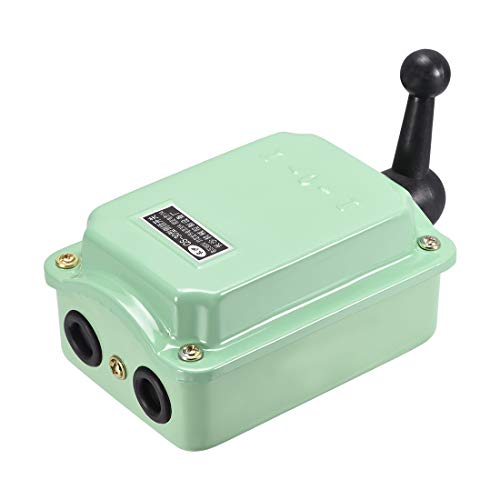
The QS-30 from uxcell is a compact, latching 3-position switch with forward, stop, and reverse settings. It supports up to 380V and 30A, with six terminals for straightforward wiring. This model is well-suited for smaller three-phase drives or CNC-related equipment where a reliable direction change is required without frequent cycling. Its mid-sized dimensions make it a practical fit for enclosures with limited space.
KO3-30A Three-Phase Forward/Reverse

The KO3-30A from VIZLKOG is a three-phase forward/reverse switch rated for 220V/380V operation at up to 30A. It includes limit switches and a rugged build suitable for industrial applications where direction control is essential for milling, conveyors, or other three-phase machines. The enclosure and design emphasize safety and ease of installation in control panels or external mounting.
KEYMOO 40A Rotary Changeover With Exterior Box
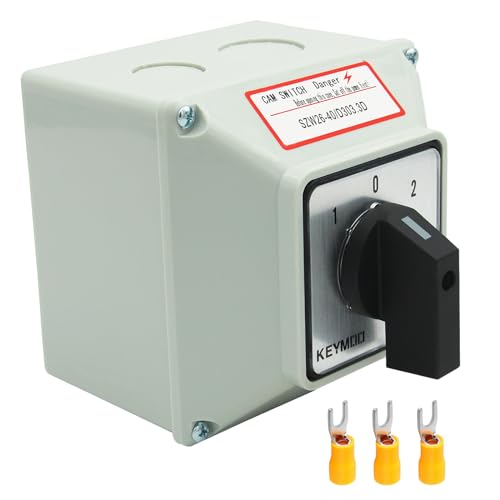
The KEYMOO 40A Rotary Changeover Switch features a 3-position ON-OFF-ON arrangement with 12 terminals and a durable exterior cam box rated IP65. This unit is designed for external mounting and offers a compact footprint suitable for workshop and industrial environments. It enables reliable three-phase motor reversal with a straightforward wiring scheme and robust contact materials designed to resist wear and corrosion.
KEYMOO 32A Rotary Changeover Switch

This KEYMOO model provides a 32A, 12-terminal, 3-pole solution with a 3-position ON-OFF-ON setup. It is designed for IP65-rated exterior boxes and is suitable for environments where moisture and dust protection is important. The compact dimensions and wiring flexibility support a range of three-phase control applications, including milling and conveyor systems that require reliable reverse and forward operation.
Buying Guide: Key Purchase Considerations
- Voltage and current ratings: Match the switch to your motor voltage (e.g., 208-230V or 440V) and current draw. Oversizing slightly can improve longevity, but ensure compatibility with enclosure space and wiring.
- Number of poles and terminals: Three-pole switches with 12 terminals are common for full three-phase control; ensure there are enough terminals for your wiring configuration and future expansion.
- Action type: Latching vs. non-latching influences how the switch behaves when actuated. Latching designs are generally safer for long runs and provide clear, stable states.
- Enclosure and protection: Exterior-box models with IP65 or better protect against dust and moisture, essential in workshop or outdoor environments.
- Mechanical durability: Look for robust materials (metal and high-grade plastics), secure locking mechanisms, and smooth operation to minimize wear over time.
- Mounting and footprint: Check physical dimensions, mounting compatibility, and space in control panels or external cabinets to avoid fit issues.
- Wiring and terminals: Confirm wire gauges (AWG) supported, terminal count, and terminal type; plan for future serviceability and torque requirements.
- Safety considerations: Implement proper interlocks or isolation when switching motor direction to prevent accidental startup or short circuits.
- Warranty and support: Prefer brands offering clear warranty terms and accessible technical support for troubleshooting and replacements.
- Application fit: For milling machines, conveyors, and general three-phase motors, prioritize switches with reliable reverse functionality and clear indication of positions.
When selecting a 3 phase reversing switch, consider the balance between enclosure protection, current capability, and the complexity of your wiring plan. The options listed above provide a range of features—from compact latching type switches to rugged exterior-box units—designed to support stable forward and reverse control in three-phase systems. For best results, map your motor specs, enclosure space, and the control panel design before purchasing, and verify that the chosen model supports your exact voltage, current, and duty cycle needs.