Answering the top buyer question: a two-bank onboard charger provides simultaneous charging and maintenance for two batteries, ideal for anglers, sailors, and weekend boaters who rely on reliable cranking power and long-term battery health. This guide highlights five 2-bank models to fit marine, starter, and deep-cycle needs, with notes on who benefits most, key strengths, and any limitations. Use the quick product table below to compare core specs at a glance.
- Best for: boaters needing compact, high-power dual banks with smart charging.
- Better for: maintaining multiple batteries in parallel or separate systems (engine and trolling motor).
- Choose this if: you want temperature-compensated charging and robust water resistance.
| Product | Bank Power (Total) | Best Battery Types | Key Benefit | Notable Limitation |
|---|---|---|---|---|
| NoCO Genius GEN5X2 | 10A (5A per bank) | Lead-Acid & Lithium | Compact design, multi-mode per bank | Higher price than entry-level models |
| NoCO GENIUS2X2 | 4A (2A per bank) | Lead-Acid & Lithium | Smart maintenance with thermals | Lower total amps for fast charging |
| FirstPower Pro 5X2 | 10A (5A per bank) | Lead-Acid & Lithium | IP68 waterproof rating, 24/7 charging | Brand less known than NOCO |
| Zrfmib Smart 2 Bank | 10A (5A per bank) | Lead-Acid & Lithium | Independent mode per battery, clear modes | Less widely reviewed |
| Battery Tender Plus 2 Bank | 5A (2.5A per bank) | Lead-Acid & LiFePO4 | Solid-state indicators, proven reliability | Lower max amperage for quick top-offs |
NOCO Genius GEN5X2: 2-Bank, 10A Onboard Charger
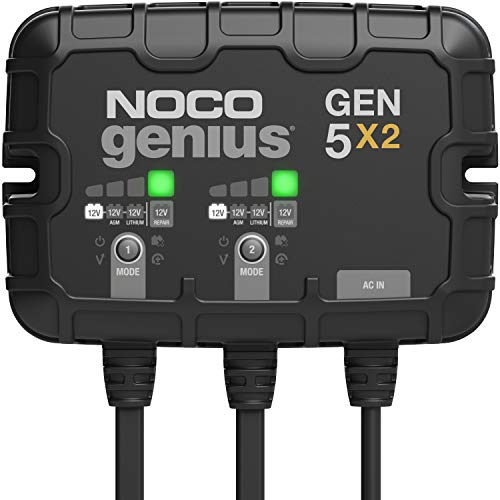
Best for: boaters needing strong, two-bank performance with aggressive charging for both lead-acid and lithium systems. The GEN5X2 delivers 10 amps total, 5 amps per bank, and supports 12V, 12V AGM, 12V Lithium, plus a Repair Mode. This model is noted for a compact footprint and robustness in harsh marine environments. Use this when rapid restoration of two separate batteries is essential and space is at a premium.
Caution: While compact, it carries a higher upfront cost relative to basic maintainers. Ensure your battery chemistry aligns with the selectable modes to avoid misconfiguration.
NOCO GENIUS2X2: 4A 2-Bank Smart Charger

Best for: owners who need a reliable two-battery solution with desulfator features and temperature compensation. It supports 6V and 12V lead-acid variants and LiFePO4, making it a flexible choice for mixed-battery garages and small boats. Choose this if you prioritize a versatile, all-in-one maintenance and charging solution over raw charge speed.
Caution: The total amperage is lower (4A total) than some 10A models, so charging two batteries quickly may take longer.
FirstPower Pro 2 Bank Marine Battery Charger 5X2

Best for: mariners seeking 24/7 onboard charging with IP68 waterproof protection. The 5X2 model provides two 5-amp banks with independent mode selection for each battery, and it supports SLA/AGM, Lithium LiFePO4, and calcium chemistries. This model stands out for continuous duty in exposed marine environments.
Caution: Availability and support vary by region; verify compatibility with your specific battery types before purchase.
Smart 2 Bank Marine Battery Charger — Zrfmib

Best for: boaters needing a straightforward two-bank solution with independent mode menus. The charger offers 12V 10A total (5A per bank) and supports SLA/AGM, Lithium, and Calcium chemistries. It’s a practical choice when clear mode selection and 24/7 operation are priorities.
Caution: It may have fewer brand-recognition advantages; confirm after-sales support in your region.
Battery Tender Plus 2 Bank
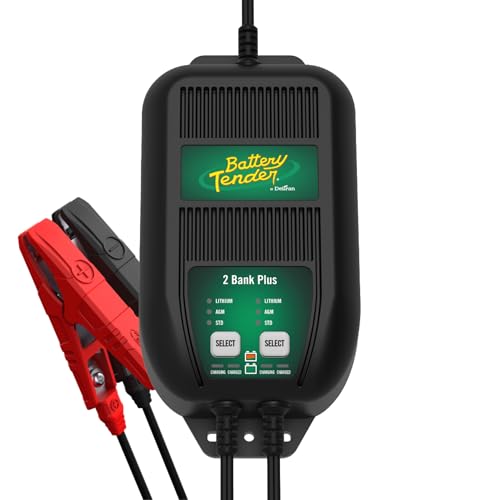
Best for: users who want a proven, reliable two-bank charger with clear status indicators. Each bank delivers 1.25 amps and incorporates temperature compensation, ensuring safe charging across a range of ambient conditions. This is a solid pick for light to moderate charging needs and for those prioritizing simple operation.
Limitation: The total amperage is lower, so it is slower for larger deep-cycle batteries or when two batteries require rapid top-offs.
Buying Guide: Key Considerations For Your Marine Dual-Bank Charger
- Battery chemistry compatibility: Ensure the charger supports your lead-acid variants (SLA, AGM, Gel) and LiFePO4 or other lithium chemistries.
- Total amperage vs. cycle needs: Higher total amps speed up charging two batteries, but smaller boats or fewer deep-cycle apps may not need top-end power.
- Independent bank control: If you operate two separate battery systems, confirm per-bank mode selection and independent charging behavior.
- Environmental rating: IP68 or similar waterproofing is valuable for exposed installations; verify marine-grade sealing and corrosion resistance.
- Temperature compensation: Look for models with built-in sensors that adjust charge voltage based on ambient temperature to prevent undercharging or overcharging.
- Repair Mode or forced charging: Some models offer a mode to revive deeply discharged batteries, which can be beneficial for stubborn cells.
- Installation footprint: Consider the physical size and mounting orientation to fit under seat lockers, in console bays, or battery trays.
- Maintenance features: Spark-proofing, reverse polarity protection, and clear status indicators help reduce installation errors and simplify monitoring.
Frequently Asked Questions
- What is a two-bank charger best for on a boat? It is ideal for maintaining two separate battery banks, such as engine starting and trolling motor, or for boats with two deep-cycle batteries.
- Can these chargers handle lithium and lead-acid batteries at the same time? Yes, many models support both, but check the specific battery chemistry modes per bank before charging.
- Is higher amperage important for dual-bank charging? Higher total amps can recharge batteries faster, especially after heavy use, but smaller boats may not need peak power.
- What is force or repair mode? It is a feature that allows charging to start even if a battery is deeply discharged, helping revive weak cells under safe conditions.
- Do I need temperature compensation? Yes, it helps optimize charging voltage across temperature variations, extending battery life and preventing over/undercharging.
- Are these chargers waterproof enough for marine use? Models rated IP68 or similar provide robust protection against water ingress in marine environments.