Answer: For reliable power conversion in industrial settings, a 15 kVA, 480V to 240V three-phase or similar transformer is ideal when you need stable three-phase output for 240V equipment and controlled voltage in demanding environments. The best options below are chosen for compatibility with industrial controls, HVAC systems, CNC machinery, and other heavy loads. They’re suitable for electricians, facility managers, and plant engineers seeking robust isolation, reliable voltage stepping, and clear wiring configurations.
Buyer types and suitability:
– Industrial facility managers: need three-phase isolation transformers to reduce noise and protect critical loads.
– HVAC and process control technicians: require stable 120/240V outputs from 480V inputs for control devices and relays.
– CNC and manufacturing technicians: look for frequency-conversion or step-down capability for compatible equipment.
– Electrical contractors: prefer units with clear wiring (Dyn11 or Wye) and rugged enclosures for dry or limited-space installations.
Summary table of selected products
| Product | Voltage In/Out | Type | Best For | Notes |
|---|---|---|---|---|
| GoHz 15kVA Isolation Transformer | 480V → 240V, 3-phase | Isolation Transformer | Three-phase industrial loads needing isolation | High efficiency, copper winding, H level insulation |
| DAYTON 15kVA Transformer (Three Phase) | 480V → 120V, 3-phase | Three-Phase Dry-Type | Industrial controls & thermostats in 480V systems | Four main voltages supported, robust protection |
| SolaHD HS1F1BS | 240/480V → 120/240V, 1-phase | Encapsulated Automation Transformer | Low-profile, single-phase control panels | Encapsulated, compact dimensions |
| GoHz Frequency Converter | 240V 3-Phase → 480V 3-Phase | Frequency Converter | Machinery needing 50/60 Hz conversion | Includes overload/over-temp protection |
| UJCTARKE Qsg-15kva Toroidal Transformer | 380V-440V to 380V-440V (auto/isolated) | Autotransformer | Compact automatic voltage adjustment | Torroidal design for tight spaces |
GoHz 15kVA Isolation Transformer, 480V to 240V

Features: 15 kVA capacity, three-phase input and output, 480V to 240V conversion, copper winding for high efficiency, H level insulation with Dyn11 wiring, dry-type air cooling. Best for three-phase industrial loads needing isolation and clean power. Limitations: may be bulky for tight spaces; check enclosure clearance.
GUSUUI TR50VA008 Transformer 480/277/240/208V to 120V

Features: Four input voltages (480V, 277V, 240V, 208V) with a 50 VA output, ideal for precise 120V loads such as AC controls. Integrated circuit breaker for overload protection. Best for systems needing flexible input voltage with simple protection. Limitations: may not handle higher current loads beyond 50 VA as a simple replacement for larger loads.
SolaHD HS1F1BS Non-Ventilated 1-Phase Transformer

Features: Encapsulated 1-phase transformer, 240/480V input to 120/240V output, compact 10″ tall footprint, suitable for automation panels. Best for control cabinets where isolation and compact size are critical. Limitation: single-phase units may not replace three-phase power where required.
GoHz 15kVA Three Phase Frequency Converter

Features: 15 kVA three-phase frequency converter, Wye wiring, inputs at 240V 3-phase, outputs adjustable up to 110V-260V phase and 0-520V line voltage depending on setting, 50/60 Hz compatibility. Best for CNC or machinery requiring frequency conversion between 50 Hz and 60 Hz. Caution: higher voltage and frequency settings require careful matching to equipment to avoid damage.
DAYTON Three Phase Transformer 15kVA 480V
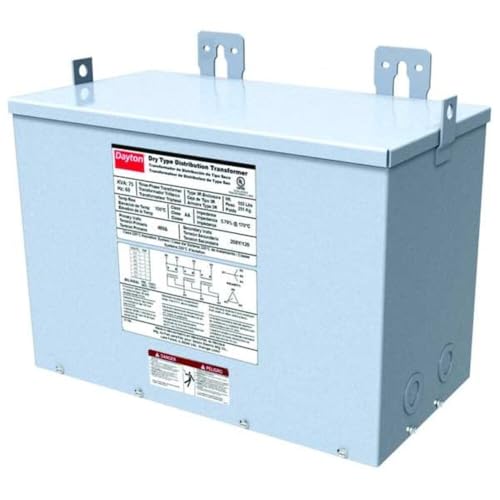
Features: Three-phase 15 kVA dry-type transformer, input 480V, output 120V or 208V depending on configuration, robust isolation for power distribution. Best for plant-wide control circuits and industrial equipment requiring stable control voltage. Limitation: some models may require external protection devices; verify wiring mode and enclosure space.
Buying Guide: Key Purchase Considerations
- Voltage compatibility: Confirm input and output voltages exactly match your equipment and distribution panel requirements. Choose units with appropriate delta or wye configurations.
- Phase and power rating: For three-phase loads, select a transformer rated for 15 kVA or higher with proper current handling. For single-phase loads, ensure the unit’s VA rating matches or exceeds demand.
- Isolation versus autotransformer: Isolation transformers reduce electrical noise and improve safety for sensitive devices. Autotransformers can be smaller but don’t provide full isolation; pick based on your risk tolerance and noise requirements.
- Cooling and enclosure: Dry-type and encapsulated designs are common. Consider air cooling for larger loads and enclosure features (airflow, mounting options, drilling, and knockouts) for space-constrained installations.
- Protection features: Look for built-in circuit breakers, thermal protection, surge suppression, and UL/CSA-related certifications where applicable for compliance and safety.
- Wiring and installation: Check winding configurations (Dyn11, Wye), terminal arrangements, and whether the unit supports your wiring scheme and field connections.
- Maintenance and longevity: Copper windings generally offer efficient performance and reduced noise. Consider units with accessible service points and cooling paths for easier maintenance.
- Space and footprint: Large three-phase transformers require sufficient clearance. Review dimensions to ensure fit in electrical rooms or panels.
Frequently Asked Questions
- What is the difference between an isolation transformer and an autotransformer?
– An isolation transformer provides electrical isolation between input and output with no direct electrical connection, improving safety and noise reduction. An autotransformer shares a portion of the winding between input and output, which can be more compact but does not provide isolation. - Can a 15 kVA transformer support 120V devices in a 480V system?
– Yes, when configured with a suitable secondary voltage (such as 120V) and proper wiring, it can power 120V devices. Check the transformer’s secondary rating and ensure it matches device requirements. - Is three-phase voltage more suitable for heavy machinery?
– Yes, three-phase power often provides smoother operation, less voltage drop, and higher efficiency for motors and large equipment compared to single-phase power. - What maintenance is typically needed for dry-type transformers?
– Regular inspections for overheating, dust buildup, and enclosure integrity; ensure cooling paths are unobstructed and protective devices are functional. - Are frequency converters necessary for all CNC machines?
– Not always. Some CNC machines run on fixed frequencies. A frequency converter is needed if your equipment requires specific 50 Hz or 60 Hz settings not provided by your current supply. - How do I choose between copper winding and other winding materials?
– Copper windings typically offer higher efficiency and lower noise, contributing to durable performance in demanding environments.