Choosing a reliable 12V 100Ah battery is essential for keeping marine electronics, trolling motors, and off-grid systems powered on the water or away from shore power. This guide reviews five leading options, covering AGM and LiFePO4 chemistries to suit different budgets and climates. We compare safety, cycle life, temperature tolerance, and charging compatibility to help you pick a durable power source for sea, lake, or campground use.
Summary of selected products
| Product | Brand | Chemistry | Key Benefit |
|---|---|---|---|
| Weize Deep Cycle AGM 12V 100Ah Battery | WEIZE | AGM | Low self-discharge; maintenance-free |
| Renogy Deep Cycle AGM 12V 100Ah Battery | Renogy | AGM | Strong safety profile; widely trusted |
| GREENOE 12V 100Ah LiFePO4 Battery Group 31 | GREENOE | LiFePO4 | Long cycle life; built-in protections |
| GRNOE 2-Pack 12V 100Ah LiFePO4 Battery Group 31 | GRNOE | LiFePO4 | Dual-pack flexibility; robust protection |
| Litime 12V 100Ah Trolling Motors LiFePO4 Battery | Litime | LiFePO4 | Bluetooth monitoring; strong cold-weather protection |
Weize Deep Cycle AGM 12V 100Ah Battery
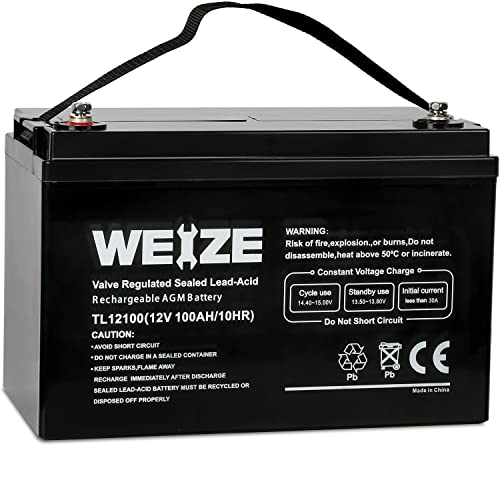
The WEIZE AGM battery is a maintenance-free 12V 100Ah unit with an AGM separator that minimizes leakage risk. Its a.m. 1-3% monthly self-discharge supports longer storage between uses, ideal for off-season boats, RV setups, and solar systems. It delivers up to 1150A peak discharge, and is suitable for trolling motors, wind setups, and marine electronics. Operating temperatures span from -10°C to 50°C, with a recommended 25°C runtime, aligning with typical coastal and inland boat environments.
Renogy Deep Cycle AGM 12V 100Ah Battery

Renogy offers a trusted AGM option with a focus on safety and performance. The battery supports series connections with no practical limitations and parallel connections up to four packs, enabling scalable capacity for larger boats or off-grid cabins. Renogy emphasizes stable chemistry and minimal troubleshooting compared with other chemistries, appealing to users seeking reliability, especially in RVs, cabins, and marine setups where safe operation matters.
GREENOE 12V 100Ah LiFePO4 Battery Group 31

This LiFePO4 option emphasizes longevity with 15,000+ cycles and a practical 10-year lifespan. It includes a smart BMS with low-temperature cut-off and safeguards against overcharge and short-circuits. The unit is lighter than traditional SLA/AGM batteries, with a compact footprint and a recommended charging voltage around 14.6V, making it suitable for RVs, marine applications, and off-grid solar systems in a range of climates.
GRNOE 2-Pack 12V 100Ah LiFePO4 Battery Group 31

This 2-pack option from GRNOE provides flexibility for larger power needs or two separate systems (e.g., two trolling motors or a dual-battery bank for extended trips). It features a smart low-temperature cut-off and an advanced BMS that protects against overcurrent, overcharge, and short circuits. Like other LiFePO4 models, it delivers long cycle life and reliable performance in marine and off-grid environments.
Litime 12V 100Ah Trolling Motors LiFePO4 Battery

Litime’s trolling-motor-oriented LiFePO4 battery emphasizes Bluetooth monitoring for quick status checks and management from a smartphone. It includes smart low-temperature protection to stop charging below 32°F and discharging below -4°F. The battery carries 20+ safety protections and IP65 rating, making it a robust choice for marine environments, RVs, and solar storage, with stability in rough conditions and cold weather.
Buying Guide: Key Purchase Considerations
When selecting a 12V 100Ah battery for marine use, consider chemistry, cycle life, temperature tolerance, and charging compatibility. Here are the main perspectives to help you decide:
- AGM vs LiFePO4: AGM batteries are typically more affordable upfront and offer maintenance-free operation, while LiFePO4 provides far longer cycle life, significantly lighter weight, and safer chemistry. If you spend extended periods away from shore power, LiFePO4 often delivers greater long-term value.
- Cycle life and depth of discharge: LiFePO4 cells usually tolerate more cycles and deeper discharge without damage. For boats with intermittent usage or frequent full loads, LiFePO4 can reduce replacement frequency.
- Weight and space: LiFePO4 packs are generally lighter for the same capacity, enabling easier installation on boats or RV compartments. AGM batteries are heavier but can be more budget-friendly for small to mid-size needs.
- Temperature performance: Marine environments vary in temperature. Look for batteries with low-temperature cut-off to prevent damage during cold months and a stable operating range for hot days at the dock or on lakes.
- Charging requirements: Check recommended charging voltages and compatibility with your solar array, inverter/charger, or alternator. LiFePO4 often requires a precise charging profile to maximize lifespan.
- Maintenance and safety features: A sealed AGM minimizes leakage risk, while LiFePO4 with a robust BMS safeguards against overcharge, over-discharge, and short circuits. IP ratings and corrosion resistance are important for saltwater use.
- Cost vs. lifetime value: Upfront cost is important, but LiFePO4’s longer life can reduce total cost of ownership. Consider replacement frequency, duty cycle, and maintenance costs when comparing options.
For boaters, RV enthusiasts, and off-grid travelers, your choice should balance immediate budget with expected runtime, climate considerations, and how often you’ll cycle the battery. The listed products provide a spectrum of options to align with different priorities, from budget-friendly AGM to high-cycle LiFePO4 systems with smart protection.