Choosing the right 120V to 240V inverter requires weighing power needs, reliability, and safety features. This guide highlights top pure sine wave inverters suitable for homes, RVs, solar setups, and off-grid environments. Each option supports 120V/240V output with varying wattage, input voltages, and feature sets to cover everything from basic camping needs to full home backup. Read on for deep-dive product sections, a concise comparison, and practical buying considerations to help you select an inverter that fits American electrical standards and daily use.
Summary table of selected products:
- BAIYITONGDA 5000W Pure Sine Wave Inverter Charger — 12V to 120V/240V output, multiple DC inputs, high efficiency
- WZRELB 4000W 48V Pure Sine Wave Inverter — 48V DC to 120V/240V split phase, LCD remote
- SUNGOLDPOWER 10000W 48V Solar Inverter — 120V/240V, dual MPPT, built-in battery charger
- LiTime 5000W Solar Hybrid Inverter Charger — 48V, parallel up to 6 units, UPS-like behavior
- Ampinvt 5000W Peak 15000W Pure Sine Wave Inverter — 24V to 120V/240V, integrated charger
BAIYITONGDA 5000W Pure Sine Wave Inverter Charger

This high-tech inverter is designed for off-grid and mobile use, converting 12V/24V/48V/60V/72V DC to 110V-120V and 220V-240V AC. It supports a broad input range and claims a 95% conversion efficiency with minimal electromagnetic interference. The unit integrates multiple protections and a buzzer alert to help prevent damage from overheating, overload, short circuits, undervoltage, and overvoltage. It is suitable for RVs, campers, solar systems, and field work where reliable power is essential.
Key features include pure sine wave output for sensitive electronics, an external fuse for safety, and versatility across various DC input voltages. The device is intended for users who require robust performance in remote or off-grid scenarios, where dependable conversion efficiency and protective features are critical.
WZRELB 4000W 48V Pure Sine Wave Inverter

This 48V DC to 120/240V AC split-phase inverter delivers strong surge capacity with 4000W continuous power and 8000W peak power. It features two 120V outlets and a universal 240V plug plus a hardwire terminal, offering flexible wiring for different setups. Efficiency reaches around 91.6%, and the LCD remote panel provides real-time status monitoring. Multi-mode operation allows simultaneous 120V and 240V outputs, making it a practical choice for larger off-grid or backup systems.
Highlights include easy remote control, multiple protection schemes, and the ability to run demanding loads like appliances or tools. The unit supports a 240V split-phase configuration, which is common in North American installations, and includes a remote control for convenient distant operation.
SUNGOLDPOWER 10000W 48V Solar Inverter

All-in-one solar charge inverter with 10000W continuous output and up to 200A battery charging capacity. It includes built-in dual MPPT solar controllers, a WIFI module for monitoring, and the flexibility to operate in split-phase 120V/240V or single-phase 120V. The unit supports multiple protection schemes and a max open-circuit voltage of 500VDC, enabling robust integration with solar arrays. It comes with a mobile app for real-time status checks and supports several operating modes to prioritize solar or utility power as needed.
Designed for substantial solar backup applications, this inverter is ideal for larger homes or off-grid setups that demand consistent, high-power output, compatible with both lithium and lead-acid battery banks. It emphasizes remote monitoring and programmable charging strategies to optimize energy use.
LiTime 5000W Solar Hybrid Inverter Charger
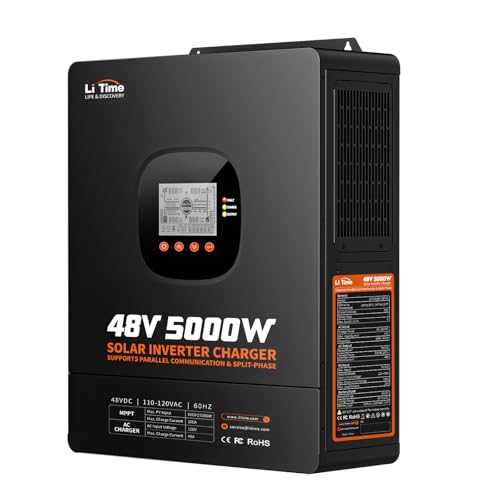
LiTime combines a 5000W inverter with a 100A MPPT solar charger in a split-phase 120V/240V capable unit. It supports up to 6 units in parallel, delivering up to 30kW total, with a built-in UPS-like function that keeps loads powered during outages. The product supports both 48V lithium and lead-acid battery configurations and offers four output modes to balance solar, grid, and battery use. A user-friendly LCD display helps monitor status and performance in real time.
With parallel operation, this inverter is well-suited for larger off-grid homes or commercial backup systems where expanding capacity is a consideration. It emphasizes energy management and resilience, making it a strong option for users planning long-term solar integration and reliability.
Ampinvt 5000W Peak 15000W Pure Sine Wave Inverter

Hybrid inverter with a 24V DC input and pure sine wave output to 120V/240V. It integrates a battery charger and AC transfer switch, delivering high transfer efficiency and isolated input/output surge protection. The unit supports different battery chemistries and allows adjustable charging current up to 35A. This flexibility makes it suitable for solar-powered or off-grid applications where a reliable, efficient inverter is required, and where battery management is an important consideration.
Buying Guide: Key Purchase Considerations
- Output voltage and phase: Check whether the inverter provides 120V in single-phase or 240V split-phase, depending on your loads and wiring preferences. Split-phase is common for homes in many regions.
- Power rating and surge: Match continuous wattage to your typical loads, and verify surge capacity to handle motor startups or peak appliances. Higher wattage units better accommodate heavy equipment.
- Input voltage and battery compatibility: Ensure the unit accepts your battery bank voltage (e.g., 12V, 24V, 48V) and supports your battery type (lead-acid, AGM, Li-ion, LiFePO4).
- True sine wave: A pure sine wave output is essential for sensitive electronics and appliances with variable speed drives or motors.
- Efficiency and EMI: Look for high efficiency (often 90%+ for quality units) and low electromagnetic interference to minimize energy loss and radio interference.
- Protection features: Over/under voltage, overload, short-circuit, overtemp, reverse polarity, and low-noise operation improve safety and longevity.
- Monitoring and control: LCD displays, remote controllers, and Wi-Fi/SMS monitoring help track performance and troubleshoot issues remotely.
- Parallel capability: If future expansion is anticipated, choose models rated for parallel operation to increase total available power.
- Installation and form factor: Consider enclosure size, mounting options, and whether a hardwired connection or plug-in outlet is preferred for your setup.
- Warranty and support: A robust warranty and accessible customer support reduce ownership risk, especially for critical backup systems.
In evaluating these options, consider your primary use case: mobile power for RVs or boats, backup power for home use, or off-grid solar systems. Higher-wattage inverters with parallel capabilities offer future-proofing but may require more complex installation. Simpler, lower-wattage units can suffice for small appliances and essential electronics, with easier setup and maintenance.