Choosing a 12V 30A battery charger involves matching charging profiles, battery chemistry, and outdoor durability to your needs. This guide highlights five top chargers designed for LiFePO4 and traditional lead-acid batteries, with attention to safety features, portability, and compatibility with deep-cycle packs commonly used in RVs, boats, or off-grid setups. Each product section includes a quick overview, key specs, and practical considerations to help you compare options at a glance.
| Product | Battery Type | Key Feature | Image |
|---|---|---|---|
| LiFbatt 12V 30A LiFePO4 Charger | LiFePO4 | Anderson connector with M8 adapter and 0V wake-up |  |
| YHCHKJ 30A Smart Charger | Lead-Acid & Lithium & LiFePO4 | 9-stage charging with LCD display |  |
| Victron Blue Smart IP22 Charger | Multiple chemistries | Wireless monitoring and adaptive management |  |
| KAISAL 12V 30A LiFePO4 Charger | LiFePO4 | IP67 waterproof with 0V wake-up |  |
| E-FAST 12V 30A LiFePO4 Charger | LiFePO4 | 0V wake-up and 3-stage charging with protective features | 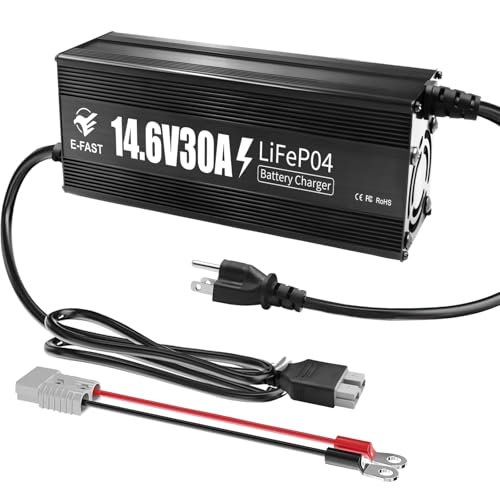 |
Note: The products above are representative options for versatile 12V 30A charging needs, particularly for LiFePO4 and lead-acid battery systems used in RVs, boats, and off-grid installations. Always verify compatibility with your specific battery model and BMS requirements before purchasing.
LiFbatt 12V 30A LiFePO4 Charger
The LiFbatt charger is a 14.6V, 30A LiFePO4 smart charger built for LiFePO4 batteries. It offers a 0V wake-up function to revive deeply discharged packs and supports a 100V-120V AC input with 50/60 Hz operation. A magnesium/aluminum alloy chassis includes a built-in cooling fan for thermal management, and the device ships with heavy-duty battery cables. An upgraded connection uses M8 terminals and a 50A Anderson connector to ensure stable charging output and longer cycle life.
Key considerations: This charger targets LiFePO4 systems, so confirm battery chemistry and BMS compatibility. The 0V wake function is advantageous for batteries that have been stored long-term. The Anderson connector supports quick, high-current connections, which reduces charging time for larger LiFePO4 packs.
YHCHKJ 30Amp Smart Battery Charger
YHCHKJ’s 30A charger is designed for 24V, 12V, and 6V batteries and supports a wide range of chemistries including sealed lead-acid, AGM, and LiFePO4. It features a 9-stage charging algorithm and a user-friendly LCD readout that displays charging voltage, current, mode, temperature, and charging state. The charger doubles as a desulfator and maintainer, making it suitable for seasonal vehicles and long-term storage. It supports multiple voltages and offers various charging modes for different battery needs.
Key considerations: Review whether the LCD metrics align with your preferred visibility and whether the device’s 9-stage profile matches your battery’s recommended charging curve. Ensure compatibility with your battery’s chemistry and BMS requirements, especially for LiFePO4 packs.
Victron Energy Blue Smart IP22 Charger
Victron Blue Smart IP22 is a high-efficiency 12V charger with adaptive battery management. It features wireless monitoring to adjust settings, monitor voltage and current, and update the charger with new features via firmware. The design emphasizes safety and thermal protection, achieving up to 94% efficiency and generating less heat than typical chargers. The single-output system is suitable for motorcycles, ATVs, RVs, and other vehicles that require reliable, smart charging with remote capabilities.
Key considerations: Wireless monitoring is convenient for remote diagnostics but requires a smartphone or web access. Verify compatibility with your vehicle’s electrical system and ensure the charger’s form factor fits your installation space. If you prefer hands-on monitoring, consider how the Victron system integrates with existing solar controllers or in-vehicle networks.
KAISAL 12V 30A LiFePO4 Charger
KAISAL’s 14.6V 30A LiFePO4 charger is designed for 12V LiFePO4 (12.8V) batteries with IP67 waterproofing and a 9-foot cable. It supports 0V wake-up to reactivate cells after BMS protection cuts, and it’s engineered for outdoor use in RVs, boats, solar systems, and off-grid applications. The one-piece die-cast aluminum housing contributes to durability in challenging environments, making it suitable for vehicles exposed to rain, dust, and vibration.
Key considerations: Outdoor durability is a major benefit, but confirm the cable length and connector types match your battery system. The 0V wake-up is helpful for revived LiFePO4 packs, but ensure your BMS is compatible with this function and that the waterproof rating aligns with your installation location.
E-FAST 12V 30A LiFePO4 Charger
E-FAST presents a 12V 30A LiFePO4 charger designed specifically for LiFePO4 deep-cycle batteries, with a 14.6V charging profile and 0V wake-up to revive depleted packs. It includes protective features such as overvoltage, short circuit, and reverse polarity protections, along with a multi-stage charging process to maximize cycle life. The charger supports 100-240V AC input and standard 50/60Hz functionality, making it versatile for international use or varying power sources.
Key considerations: The core strength is LiFePO4 compatibility and battery revival features. Check whether your BMS requires specific wake-up behavior and verify connector compatibility with your battery terminals. Consider ventilation and mounting options for heat dissipation during high-current charging.
Buying Guide: Key Purchase Considerations for 12V 30A Chargers
Battery chemistry compatibility: LiFePO4 and lead-acid batteries have different charging profiles. Ensure the charger supports your battery type, or you risk reduced capacity, shortened lifespan, or safety risks. Some models offer multi-chemistry support; verify the exact battery types listed by the manufacturer.
Wake-up and BMS features: The 0V wake-up function can reactivate deeply discharged LiFePO4 cells protected by a BMS. Confirm that your BMS supports wake-up charging and that the charger’s wake-up sequence aligns with your system’s protection mechanisms.
Connectivity and monitoring: Some chargers provide remote monitoring, LCD readouts, or wireless management. Consider whether you need on-site visibility or remote control, and ensure your setup can access any companion apps or firmware updates.
Durability and enclosure: Outdoor or mobile installations benefit from IP ratings, rugged enclosures, and weather-sealed connectors. If you plan to mount the charger outdoors or on a trailer, prioritize waterproof or dustproof designs and robust connectors.
Connector compatibility: Chargers may use Anderson connectors, M8 terminals, or standard ring terminals. Match the charger’s output connectors to your battery bank’s input hardware to ensure safe, secure connections.
Efficiency, heat management, and safety: High current charging generates heat. Look for built-in cooling, thermal protection, and short-circuit/overvoltage protections. Efficient models reduce energy loss and temperature rise, supporting longer equipment life.