Whether you’re a DIY mechanic, a professional shop, or a fleet operator, a reliable 12/24V battery charger and engine starter is essential. This guide highlights five top options that cover heavy-duty charging, portable jump-start capabilities, and precise control for different battery chemistries. The selections are best for users who need quick starts, safe automatic charging, and durable builds for frequent use. Below is a quick summary table of the chosen products to help you compare at a glance.
| Product | Best For | Key Power | Notes |
|---|---|---|---|
| Schumacher DSR124 ProSeries | Heavy-duty vehicles; trucks and boats | 330A max | Automatic charging; wheels for mobility |
| Schumacher SC1400 Wheeled | All-around automotive and marine batteries | 300A start; 60–20A boost | 4-in-1; maintainer; smart trickle charge |
| Schumacher SC1633 Wheeled Manual | Precision control enthusiasts | 200A start; 25–10A charging | 2-in-1; manual timer for stage control |
| Schumacher SC1445 Wheeled Manual | Fleet vehicles and high-demand starts | 250A start; 25–10A charging | Durable steel case; 135-minute timer |
| Clore JNC1224 Jump Starter | 12/24V jump-start focus; portable fleets | 3400/1700 peak amps | High peak power; robust leads |
Schumacher DSR ProSeries 6V/12V/24V Automatic Charger

The DSR124 model combines automatic charging with a strong 330A engine start capability. It supports 6V, 12V, and 24V batteries and features reverse hook-up protection and microprocessor-based overcharge prevention. Best for shops or variable-use environments where convenience and safety matter. This unit is well suited for trucks, SUVs, boats, and other heavy-duty applications. A potential limitation is its size and weight for tight spaces or home garages.
Schumacher SC1400 Wheeled Automatic 6A Car Charger and 300A Starter
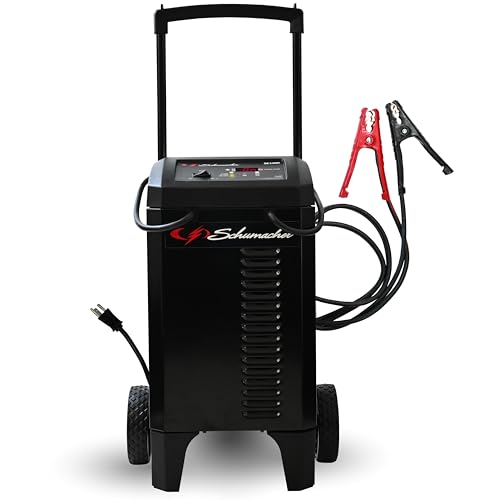
This 4-in-1 device starts, charges, maintains, and reconditions batteries. It delivers immediate 300A engine starts and offers 60A to 20A boost charging plus a 6A to 2A 12V charging/maintenance range. It’s best for automotive enthusiasts and small business use where a versatile, all-in-one unit is preferred. It may be bulkier than non-wheeled models and requires space for operation and storage.
Schumacher SC1633 Wheeled Manual 10A Charger and 200A Starter
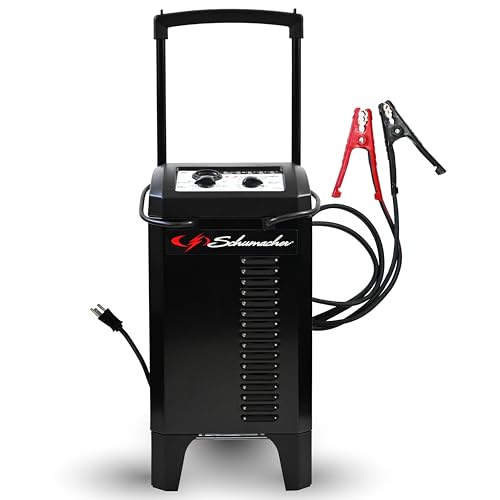
This 2-in-1 unit starts and charges with a 200A engine start and 50A/12V/24V boosting options. It gives precise control via a 135-minute timer for each charging phase, making it ideal for pro mechanics who need tailored charging profiles. A limitation is the manual operation requirement, which may not suit users seeking fully automatic charging.
Schumacher SC1445 Wheeled Manual 10A Charger and 250A Starter

Delivering a 250A engine start and 135-minute timer control, SC1445 is built for durability and heavy use in garages and fleet environments. It’s a strong choice for fleets that need reliable high-power starts with manual control for battery customization. A potential downside is the manual operation complexity for casual users.
Clore Automotive Jump-N-Carry JNC1224

The JNC1224 offers a 3400 peak amps at 12V and 1700 peak amps at 24V, with heavy-duty welding cable leads. This model is best for on-the-go jump starts in larger vehicles or fleets that require high peak power and robust portability. It may be heavier to transport and store compared to compact models.
Buying Guide: Key Purchase Considerations
- Voltage and battery compatibility: Ensure 12V/24V support if you operate mixed battery chemistries or different vehicle classes.
- Start power vs charging power: Distinguish between engine-start current and charging amperage to match your typical needs (emergency starts vs long-term maintenance).
- Portability: Wheels and handles improve mobility in shops or garages; consider cable length and clamp quality for convenience and safety.
- Automation vs manual control: Automatic models reduce supervision but may limit customization; manual timers allow tailored charging profiles for specific batteries.
- Durability and warranty: Steel frames, robust casings, and proven service support help in heavy-use environments.
- Safety features: Look for reverse-hookup protection, short-circuit protection, and automatic shutoff to prevent damage to batteries and equipment.
Frequently Asked Questions
- What is the difference between a charger and a jump starter?
– A charger restores battery charge over time; a jump starter provides a high-current boost to start a dead engine. - Can I use a 12V/24V device on both 12V and 24V batteries?
– Yes, if the unit explicitly supports both voltages; ensure settings are correct for each battery type. - Are automatic units safer for beginners?
– Generally yes, because they manage charging cycles automatically and reduce human error. - What should I consider for fleet use?
– Look for high peak starting power, durable construction, long cable runs, and easy maintenance features. - Is a manual timer necessary for all batteries?
– Not always; it is beneficial when you need precise control for sensitive or older batteries. - Do these units require professional installation?
– Most models are plug-and-use; follow the manufacturer’s safety instructions for operation.