Answering the common buyer question: which 1000W-capacity charge controller best suits a wind-solar hybrid setup or a high-volume solar system? The following selections optimize energy capture, battery protection, and ease of use for off-grid homes, RVs, boats, and street-lighting projects. The top picks include models tailored for wind and solar combinations, pure solar systems with MPPT efficiency, and robust LCD-display regulators for easy monitoring. This guide highlights who each product is best for, plus practical cautions to consider before buying.
Buying quick reference: at-a-glance comparison
- Best overall for wind-solar hybrid setups: VQP 2000W Wind Solar Hybrid Charge Controller.
- Best value MPPT for mixed systems: POWLAND 100A MPPT Solar Charge Controller.
- Best for LCD visibility and precise control: ELUSH Upgraded 100A MPPT Solar Charge Controller.
- Best for compact wind+solar integration: iSunergy 1000W Wind Solar Hybrid Charge Controller.
- Best for smart monitoring and Bluetooth features: Victron Energy SmartSolar MPPT (15A, 12/24V).
VQP 2000W Wind Solar Hybrid Charge Controller
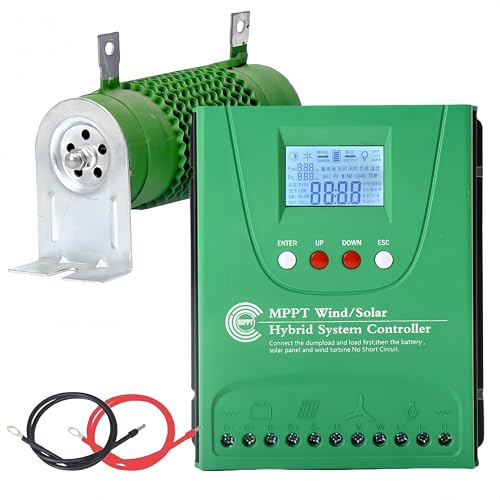
Best for full wind-solar hybrid systems that demand combined input handling. This controller supports wind up to 1000W and solar up to 1000W, with 12V/24V battery compatibility. It uses boosted MPPT charging for wind at low speeds and PWM charging for solar panels to ensure safe, efficient energy capture. The dual-input design makes it ideal for off-grid homes, boats, and street-lighting projects where both wind and sun are available. Caution: exact performance depends on wind consistency and panel orientation.
ELUSH Upgraded 100A MPPT Solar Charge Controller

Best for versatile solar-only systems with high efficiency. This controller auto-detects 12V/24V/36V/48V configurations and provides dual USB ports, a backlit LCD, and seven operating modes. It claims high MPPT tracking efficiency (no less than 99.5%) and robust protections including over-voltage, over-current, reverse connection, and overheating. Choose this if you need precise time control and a detailed display for monitoring battery voltage in deeper-cycle setups. Limitation: emphasis is on solar input; wind compatibility is not stated.
iSunergy 1000W Wind Solar Hybrid Charge Controller

Best for compact wind-solar integrations with a straightforward interface. This PWM-based hybrid controller manages wind and solar inputs with a digital LCD that displays battery voltage and charge state. It’s described as economical and practical, with adjustable controls to fit various environmental conditions. Best for small off-grid setups or educational installations where user-friendly operation is prioritized. Caution: PWM charging is typically less efficient at extreme conditions than modern MPPT, but adequate for modest systems.
POWLAND 100A MPPT Solar Charge Controller

Best for high-capacity solar systems needing robust protection and multi-stage charging. This 100A MPPT unit supports 12V/24V/36V/48V batteries with four-stage charging (bulk, boost, float, equalize) and comprehensive protection features. It is suitable for solar RVs, homes, or workshop setups that require efficient real-time MPPT tracking and broad battery compatibility. Limitation: no wind input support is listed, so it’s solar-only.
60A MPPT Solar Charge Controller by EARNMee
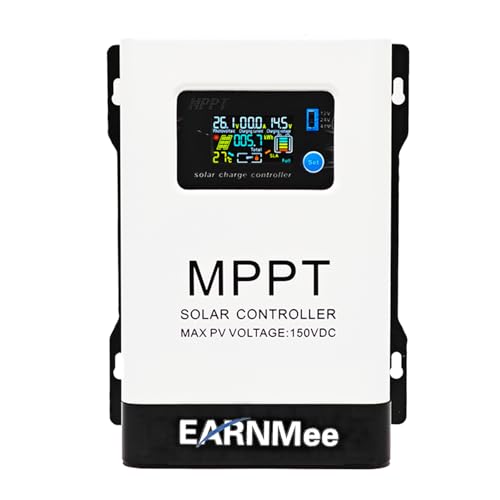
Best for large RVs and heavy-duty solar systems that require a higher input range. It supports 18-145V input, with adjustable 12/24/48V output, and claims compatibility with lead-acid and lithium batteries. It emphasizes versatility and protection (short circuit, overload, over-voltage, and load management). Caution: as a manual-output unit, setup may require more user attention to optimize battery type and voltage settings.
Renogy Rover 40A MPPT Charge Controller

Best for off-grid systems needing reliable MPPT performance with multi-battery compatibility. The Rover 40A integrates 12V/24V systems with support for gel, sealed, flooded, and lithium batteries. It also includes storm-ready protections and anti-lithium recovery techniques. Choose this if you value established Renogy reliability and compatibility with common battery chemistries. Caution: 40A capacity may be limiting for very large arrays in peak sun conditions.
EcoSolLi 120A MPPT Solar Charge Controller
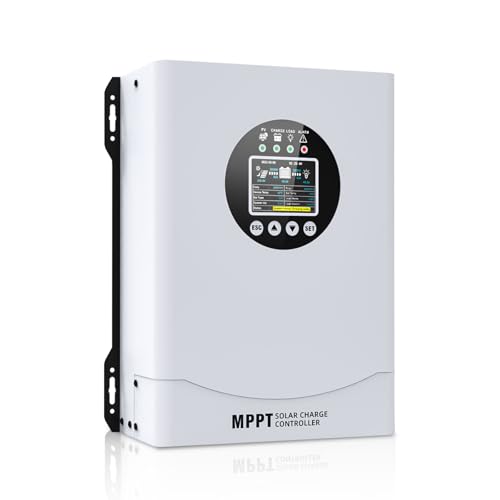
Best for very large solar installations needing high current and wide input voltage. This 120A MPPT controller supports a broad PV input range and high efficiency tracking (up to 98%). It features multiple protections (overcurrent, overvoltage, discharge, over-temperature) and supports various battery chemistries, including lithium. Use this if expansion and heavy solar demand are anticipated. Caution: higher current means more heat management is necessary.
Buying Guide: 1000W Charge Controllers for Wind and Solar Systems
- System type: Decide between wind-solar hybrids or solar-only. Hybrid controllers handle wind input, but solar-only units may offer simpler setup and robust MPPT tracking.
- Voltage and battery compatibility: Check whether the unit supports 12V/24V systems or higher like 36V/48V. Match with your battery chemistry (lead-acid, LiFePO4, etc.).
- MPPT vs PWM: MPPT controllers maximize energy harvest, especially in variable sunlight; PWM is simpler and often sufficient for smaller or educational setups.
- Protection features: Look for over-voltage, short-circuit, reverse polarity, surge, and temperature protections. For harsh environments, storm-ready options are valuable.
- Display and user interface: LCD displays help with monitoring voltage, charging stages, and battery state. Backlit displays improve readability in dim environments.
- Expansion potential: If you plan to scale, consider higher amperage or modular solutions with compatible accessories and multi-controller synchronization.
- Installation considerations: Ensure mounting space, heat dissipation, and cable gauge meet the system’s current and voltage requirements.
Frequently Asked Questions
- What is the difference between MPPT and PWM chargers? MPPT controllers extract more energy by dynamically tracking the optimal power point, especially under variable irradiance; PWM controllers are simpler and often cheaper but may waste energy under high-voltage, low-current conditions.
- Can I run wind and solar on the same controller? Some controllers are designed for wind-solar hybrids, while others are solar-only. Verify input limits and ensure the device supports both energy sources before pairing.
- What battery types are supported? Look for compatibility with lead-acid, lithium, and other chemistries. Some models explicitly list LiFePO4 compatibility or recovery features for lithium batteries.
- Why is a backlit LCD important? It improves visibility in bright outdoor environments and low-light conditions, aiding field setup and ongoing monitoring.
- What ventilation does the unit require? High-current controllers generate heat; provide ventilation or heat sinking to maintain performance and prevent throttling.
- Should I choose a higher amperage than my current needs? Yes, selecting a controller with a higher rated amperage can accommodate system expansion and improve efficiency during peak sun or wind.