When you need reliable, solar-powered fencing protection across pastures, choosing the right charger matters. This guide highlights five top 10-mile or higher solar fence chargers, featuring portable design, day/night modes, and durable construction for varying weather. Each option is designed to keep livestock safe, deter predators, and operate with minimal maintenance. Review the specs, power delivery, and installation notes to find the best fit for your fencing needs.
| Product | Coverage | Key Benefit |
|---|---|---|
| PLOWIC 10 Miles Solar Fence Charger | Up to 10 miles | Lightweight portability with day/night mode |
| Andmon MINI400 20 Miles | Up to 20 miles | High energy output with long runtime |
| Epoify 24 Hour Solar Fence Charger | Up to 10 miles | All‑in‑one design; 24/7 protection |
| Zhangmengge 20 Miles Solar Fence Charger | Up to 20 miles | Thick solar panels; durable in varied weather |
| Zareba ESP10M-Z | Up to 10 miles | Versatile mounting; reliable U.S. tested design |
Note: The products listed here are selected for performance, portability, and suitability for rural settings in the United States. Specifications reflect typical performance and may vary with weed growth, installation, and fence impedance. Always follow local guidelines and safety practices when installing electric fencing.
10 Miles Solar Fence Charger: PLOWIC

PLOWIC offers a compact, portable solar fence charger designed for up to 10 miles of fencing. It includes a day/night mode, enabling continuous protection across varying light conditions. The unit is built for easy installation and mobility, making it suitable for temporary fencing setups or rotating pastures. The system relies on a built-in solar panel and efficient battery management to maintain power through daily cycles. This charger is well-suited for small to mid-sized operations seeking dependable solar power with straightforward setup.
Features indicate a focus on portability and practical energy delivery, with a design that supports quick mounting to steel rods and simple integration with existing fences. While compact, the device is intended to deliver stable energy to deter herbivore and predator access. Weather resilience and battery efficiency are highlighted, emphasizing reliable power for 24-hour use across diverse environments.
24 Hour Solar Fence Charger, 10 Miles — Epoify

Epoify presents a 24-hour solar fence charger with a 10-mile coverage range and a robust 0.18J output energy. The device is described as portable and designed to operate continuously, including through inclement weather. An all-in-one design harnesses a rechargeable solar panel and lithium-ion technology to power a fence around the clock, offering dependable protection for livestock and property. This model emphasizes extended runtime and resilience, which can be valuable when fencing spans large or remote areas.
Key advantages include its portable form and the ability to maintain fence charge across day-night cycles. It is described as capable of handling variable weather conditions and providing reliable energy storage for ongoing operations. The configuration aims to balance energy output with battery management, ensuring protection even on days with limited sun.
10 Miles Solar Fence Charger, 0.18J — Zhangmengge

The Zhangmengge model targets up to 10 miles of fencing with a 0.18J energy output, offering mid-range power and portability. It emphasizes continuous protection with 24/7 operation, relying on an integrated solar panel and internal battery to sustain fencing energy through day and night. The design aims to provide consistent performance in typical agricultural settings while accommodating weather variations.
Users can expect easy installation and a convenient all-in-one setup, with a focus on reliable energy without frequent solar recharging. The charger’s stated features suggest suitability for small to medium farms, pet enclosures, and livestock management across modest perimeters.
Zareba ESP10M-Z Solar Powered Fence Charger — 10 Mile
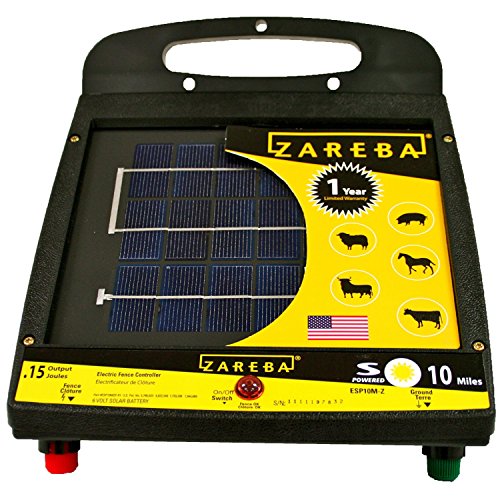
Zareba’s ESP10M-Z is a 10-mile solar-powered fence energizer with low impedance and predator deterrence features. It includes a built-in mounting bracket suitable for T-posts, Y-posts, and round-wood posts, simplifying installation on various fence layouts. The product is positioned as a reliable option for livestock containment and wildlife control, offering a two-week solar energy storage capability in favorable conditions and efficient energy delivery for extended fence lines. This model is well-regarded for its US testing and warranty support.
Performance notes emphasize versatility in mounting and consistent energy delivery, even as weed growth or climate changes affect fence conditions. The ESP10M-Z is often chosen by operators seeking a balanced combination of coverage, durability, and straightforward installation in standard farm setups.
Buying Guide: How to Choose a 10 Mile Solar Fence Charger
Key considerations help determine the best fit for your operation. The following perspectives cover efficiency, installation, maintenance, and value across common farm scenarios.
- Coverage and energy output: Compare miles of fence coverage and joule output. Higher joule ratings generally imply stronger shock, which can deter more determined predators and larger livestock. Ensure the model matches your fence length and impedance for optimal performance.
- Power source reliability: Look for built-in solar panels with efficient battery management. Lithium or sealed lead-acid options affect runtime, cold-weather performance, and maintenance needs. Consider models with day/night modes for 24/7 protection in varying daylight.
- Durability and weather resistance: Since units operate outdoors, assess IP ratings (dust and water resistance), operating temperatures, and rugged housing. Products designed for extreme temperatures often outperform in the field.
- Portability and installation: For farms with multiple pastures, portable chargers save time. Check mounting options (T-post, Y-post, or wall mount) and the weight/bulk for easy relocation between fences.
- Maintenance and warranty: Longer warranties and US-based testing can provide peace of mind. Consider battery replacement intervals and ease of service if field maintenance is needed.
- Weed management and impedance: Weeds and tall vegetation reduce efficiency. Some chargers include higher impedance tolerance or weed-friendly designs—factor weed clearance into your maintenance plan.
- Safety and compliance: Ensure devices comply with local electrical safety standards. Follow best practices for safe fence installation, including proper grounding and warning signage as needed.
For larger operations or remote grazing areas, prioritize models with extended runtime and larger battery capacity to minimize sun dependency. If you need rapid deployment across multiple fences, portability and quick mounting features will save time and labor. Compare the five options in terms of your perimeter length, livestock type, climate, and maintenance resources to select the best long-term solution.